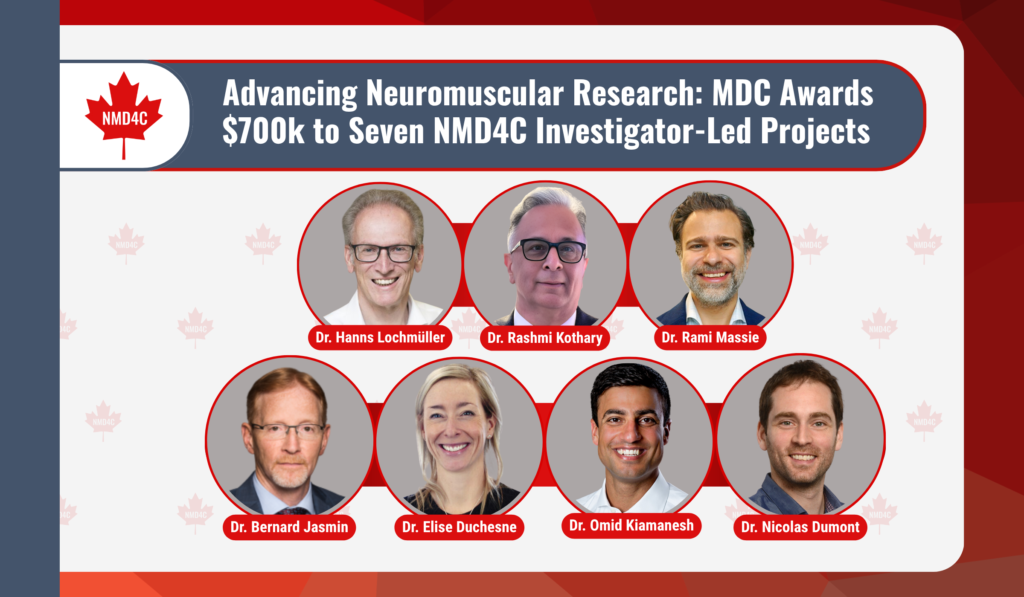
Advancing Neuromuscular Research: MDC Awards $700k to Seven NMD4C Investigator-Led Projects
We’re proud to share that neuromuscular research led by our NMD4C Investigators and Leads; Dr. Hanns Lochmüller, Dr. Rashmi Kothary, Dr. Rami Massie, Dr. Elise Duchesne, Dr. Omid Kiamanesh, and Dr. Nicolas Dumont, have been recognized in Muscular Dystrophy Canada’s 2026 Neuromuscular Clinical and Translational Research Grant announcement. Drawing from MDC’s national funding update, we’re highlighting the important work being supported this year and the impact these projects will have across the Canadian neuromuscular community.
Read how these grants are advancing neuromuscular research across Canada and strengthening national research impact below:
The MDC 2026 Clinical and Translational Science Research Grant Recipients:
 Dr. Bernard Jasmin
Title: Characterization of Bitter Melon Natural Compounds as Novel Therapeutics for Myotonic Dystrophy – University of Ottawa
Disorder Covered: Myotonic dystrophy type 1
Myotonic dystrophy type 1 (DM1) is a genetic neuromuscular disorder that affects muscles and multiple body systems, and current treatments only manage symptoms without slowing disease progression. This project will investigate a potential new therapy using natural compounds derived from bitter melon, which may activate AMP-activated protein kinase (AMPK), a protein linked to improved muscle health. By studying whether these compounds can safely activate AMPK and enhance muscle function in DM1 models, the research aims to identify a promising new treatment approach that could improve muscle health and quality of life for people living with DM1.
 Dr. Rashmi Kothary
Title: Investigating Prenatal Therapy for Spinal Muscular Atrophy – Ottawa Hospital Research Institute
Disorder Covered: Spinal muscular atrophy
Spinal muscular atrophy (SMA) is a genetic neuromuscular condition that causes progressive muscle weakness. Although treatments are available, they are typically given after birth, even though research shows the disease process begins during pregnancy. This project will use a mouse model of SMA to study whether treatment during pregnancy can better protect developing nerves and muscles, helping determine if earlier intervention could improve outcomes and guide future treatment approaches for children born with SMA.
 Dr. Hanns Lochmüller
Title: Uncovering Novel Therapeutic Strategies for the Treatment of Riboflavin Transporter Deficiency – Children’s Hospital of Eastern Ontario
Disorder Covered: Riboflavin transporter deficiency
Riboflavin transporter deficiency (RTD) is a rare genetic condition that typically begins in childhood and can cause muscle weakness, balance problems, and serious breathing difficulties. The disease occurs because the body cannot properly absorb riboflavin (vitamin B2), which cells need to produce energy. While high-dose riboflavin treatment helps some patients, it does not stop disease progression for everyone. This research will explore new strategies to improve how the body uses riboflavin by testing three approaches aimed at increasing its availability and supporting cellular energy production, with the goal of identifying new drug therapies and paving the way for future clinical trials.
 Dr. Rami Massie
Title: Characteristics of SORD-Related Polyneuropathy in a Large Canadian Neuropathy Cohort – McGill University
Disorder Covered: Charcot-Marie-Tooth disease
Hereditary neuropathies such as Charcot-Marie-Tooth disease (CMT) damage peripheral nerves, causing muscle weakness, sensory loss, and difficulty walking, and currently have no cure. Researchers have recently identified mutations in the SORD gene as a cause of a form of hereditary neuropathy that may be one of the most common inherited sources of nerve damage worldwide. As new treatments targeting this condition are being developed, this project will analyze data from a large Canadian neuropathy cohort to determine how common SORD-related neuropathy is in Canada and better understand how it presents, helping support clinical trial readiness and future advocacy to ensure Canadians can access emerging therapies.
 Dr. Elise Duchesne
Title: Improving Respiratory Health and Access to Care by Telerehabilitation in Myotonic Dystrophy Type 1 – Université Laval
Disorder Covered: Myotonic dystrophy type 1
Respiratory complications are a significant health risk for people living with myotonic dystrophy type 1 (DM1) due to weakness in the muscles used for breathing and coughing, which can increase the risk of infections like pneumonia. While previous research successfully improved inhalation strength, it did not lead to meaningful improvements in physical function because exhalation and coughing muscles were not addressed. This new study will test an eight-week, comprehensive virtual respiratory training program that targets inhalation, exhalation, and endurance, with the goal of improving respiratory health, enhancing quality of life, and helping establish a new standard of care for people living with DM1.

Dr. Omid Kiamanesh
Title: Optimizing Cardiac Surveillance in Female Dystrophinopathy Carriers: A Comparative Multi-Modality Imaging and Biomarker Study
Disorder Covered: Duchenne muscular dystrophy
Duchenne muscular dystrophy (DMD) is a genetic condition that causes progressive muscle weakness and primarily affects boys. Females who carry the DMD gene were once believed to be unaffected because many do not show obvious muscle symptoms. However, recent research shows that up to half of female carriers can develop heart-related complications over time, including the buildup of scar tissue in the heart that may lead to heart failure. Detecting these changes early is important so that care and monitoring can begin before serious complications develop.
Currently, the most accurate way to detect these heart changes is through a specialized imaging test called cardiac magnetic resonance imaging (CMRI). While CMRI is considered the gold standard, it is expensive and not always easy to access across Canada, making it difficult to use for routine screening. This study will investigate whether more accessible tools, such as echocardiography (heart ultrasound) and biomarkers found in blood tests, can help identify female carriers who may be developing early signs of heart involvement.
By comparing these different approaches, the study aims to develop a more practical and efficient screening strategy for female carriers of DMD. This could help ensure earlier detection of heart complications, improve monitoring and care, and allow CMRI to be prioritized for those who are most at risk. Ultimately, this research seeks to strengthen the care pathway for female carriers and support better long-term heart health.
 Dr. Nicolas Dumont
Title: Targeting Mitochondria for the Treatment of Myotonic Dystrophy Type 1 – CHU Sainte-Justine
Disorder Covered:Myotonic dystrophy type 1
Myotonic dystrophy type 1 (DM1) is a genetic neuromuscular disease that causes progressive muscle weakness and can affect many parts of the body. In healthy muscle, specialized cells called muscle stem cells help repair and rebuild damaged muscle tissue. However, recent research shows that in people with DM1, these muscle stem cells do not function properly.
In DM1, muscle stem cells stop dividing earlier than they should and gradually lose their ability to replace damaged muscle fibers. This contributes to the progressive loss of muscle strength seen in the disease. One possible reason for this dysfunction may involve mitochondria, which are the energy-producing structures inside cells that help power many important cellular processes, including cell division.
Our previous work has shown that mitochondria in DM1 muscle stem cells have abnormal shapes and reduced ability to produce energy. These findings suggest that mitochondrial dysfunction may play an important role in the failure of muscle stem cells to properly repair muscle tissue.
This project will investigate how mitochondrial problems affect muscle stem cell function in DM1 and explore potential strategies to restore their activity. By better understanding this process, our research could help identify new therapeutic approaches aimed at improving muscle repair and slowing disease progression for people living with DM1.
These projects reflect the depth, innovation, and collaborative strength of Canada’s neuromuscular research community. We congratulate all 2026 grant recipients and extend our appreciation to Muscular Dystrophy Canada for their continued investment in clinical and translational science.
Together, we’re strengthening national research impact and advancing meaningful progress for people living with neuromuscular conditions across Canada.
Read MDC’s Full Announcement
Read next...
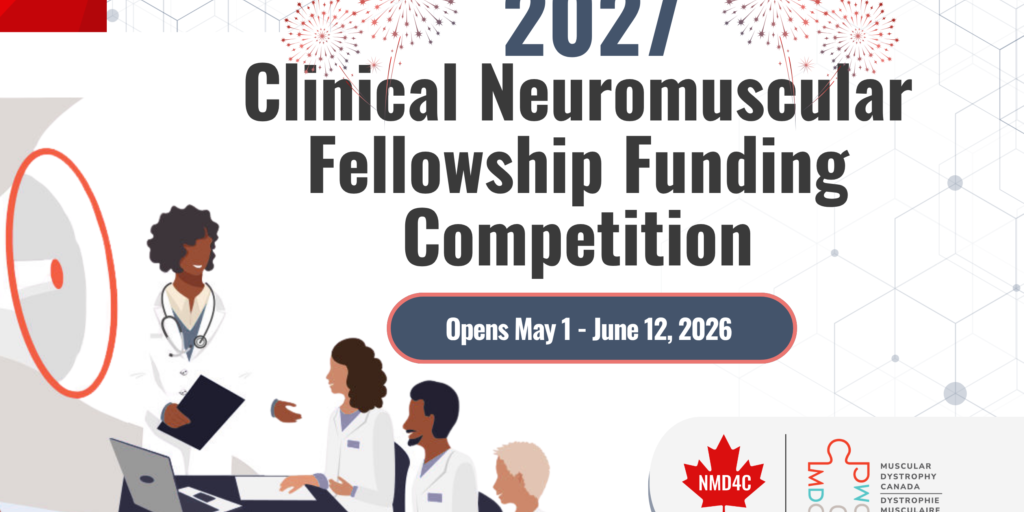
Sixth Annual NMD4C and MDC Clinical Fellowship Competition from Opens May 1st
Together, NMD4C and MDC are excited to open our 2027 annual funding competition to provide clinical fellowship award(s) in neuromuscular medicine and electromyography (EMG)! This annual funding competition provides one-year salary support ($80,000) for early-career clinicians to participate in Canadian neuromuscular medicine and EMG fellowship training programs.
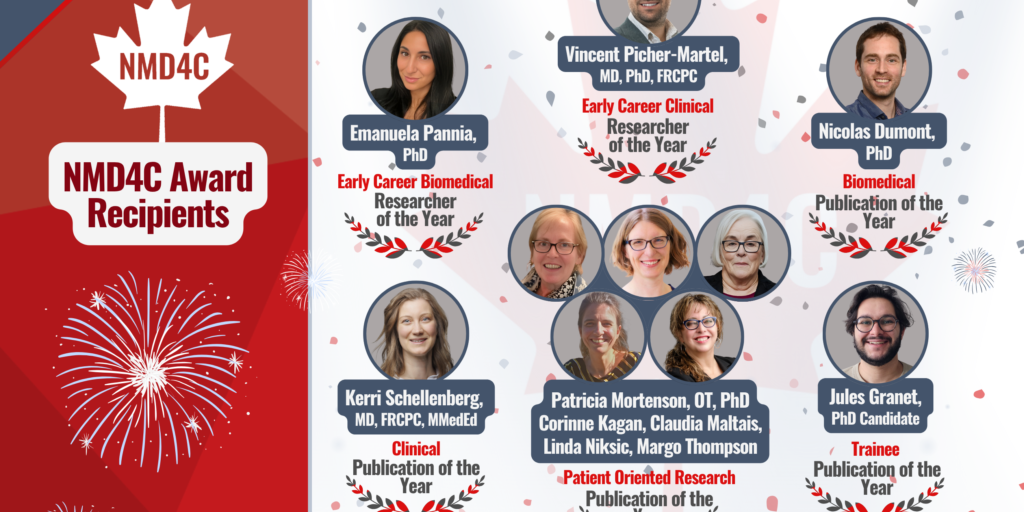
Announcing the 2026 NMD4C Award Recipients
We are excited to announce the recipients of the 2026 NMD4C Awards, recognizing excellence, leadership, and impact across Canada’s neuromuscular research community. In this fourth cycle, the program introduces two new award categories, and expand on our ability to celebrate the work of contributions of trainees and patient partners who strengthen our national network.

Expanding Our Impact: NMD4C BSTC Launches New Subcommittees and Welcomes New Members
We are so excited to introduce the new members of the NMD4C Basic Science Trainee Committee! This enthusiastic group of researchers from across the country is stepping up to contribute to some of our most important initiatives for trainees.