Linking clinicians and lab researchers for gene discovery: New publication on the Canadian Rare Disease Models and Mechanisms network
Over 70% of rare diseases are genetic in origin, but our understanding of the biological function of the 19,000 genes in the human genome is still often inadequate to reliably predict whether a defect in a particular gene is likely to cause a specific disease. Now that sequencing technologies that look for defects across the whole genome are becoming commonplace in diagnostics, clinicians attempting to diagnose their patients increasingly encounter the situation where they suspect a certain defect of being causative of the patient’s disease but do not have sufficient biological evidence to provide a certain diagnosis. To get from a “suspicion” about a defect in a gene not previously associated with a disease to biological proof of its effect requires extensive further research in cell and animal models, and this step is frequently one that the original clinician does not have the resources to perform.
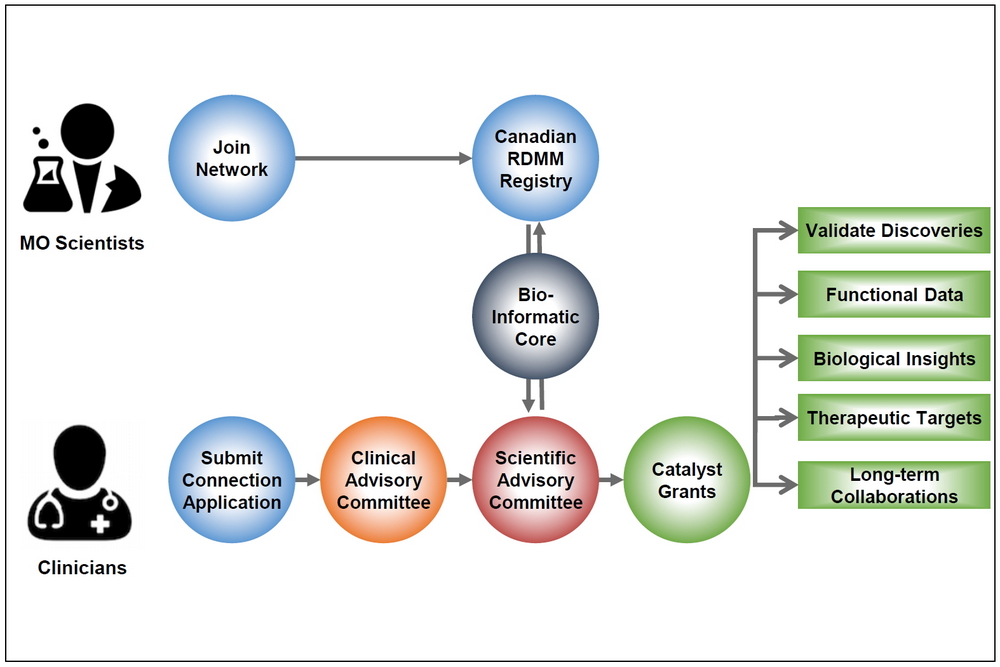
The Canadian Rare Diseases Models and Mechanisms (RDMM) network was established to connect clinicians discovering new disease genes with Canadian scientists able to study equivalent genes and pathways in model organisms. It has developed a registry of more than 500 Canadian model organism scientists, representing expertise for over 7,500 human genes. To date, it has made 85 connections between clinicians and the scientists studying their genes of interest and has provided funding for 105 projects. These collaborations help confirm variant pathogenicity and unravel the molecular mechanisms of rare diseases, and also test novel therapies and lead to long-term collaborations. NMD4C collaborates with the RDMM network to ensure that neuromuscular clinicians with a gene of interest have the opportunity to seek scientists with the relevant expertise, as well as enabling NMD scientists to register with the network in order to facilitate future collaborations.
The story of the RDMM to date is nicely summarised in this new article by Boycott et al in the American Journal of Human Genetics:
Boycott KM, Campeau PM, Howley HE, Pavlidis P, Rogic S, Oriel C, Berman JN, Hamilton RM, Hicks GG, Lipshitz HD, Masson JY, Shoubridge EA, Junker A, Leroux MR, McMaster CR, Michaud JL, Turvey SE, Dyment D, Innes AM, van Karnebeek CD, Lehman A, Cohn RD, MacDonald IM, Rachubinski RA, Frosk P, Vandersteen A, Wozniak RW, Pena IA, Wen XY, Lacaze-Masmonteil T, Rankin C, Hieter P.
The Canadian Rare Diseases Models and Mechanisms (RDMM) Network: Connecting Understudied Genes to Model Organisms
Am J Hum Genet. 2020 Feb 6;106(2):143-152. doi: 10.1016/j.ajhg.2020.01.009.
PMID: 32032513
Read next...
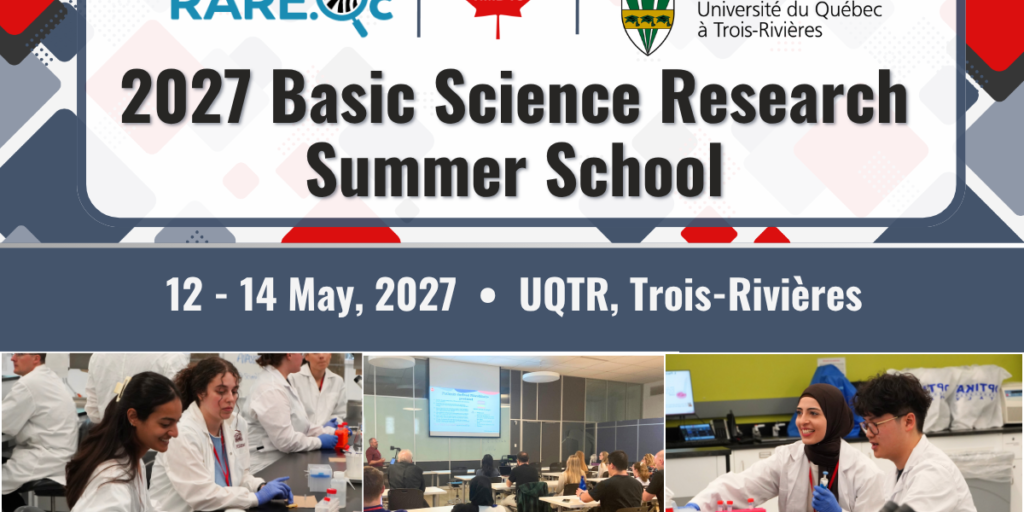
2027 NMD4C–RARE.Qc Basic Science Research Summer School Applications Are Now Open!
Deadline: December 1, 2026
2027 NMD4C–RARE.Qc Basic Science Research Summer School Applications Are Now Open!
The summer school offers neuromuscular and rare disease research trainees the opportunity to participate in an intensive three-day training program focused on cutting-edge experimental and translational research techniques.