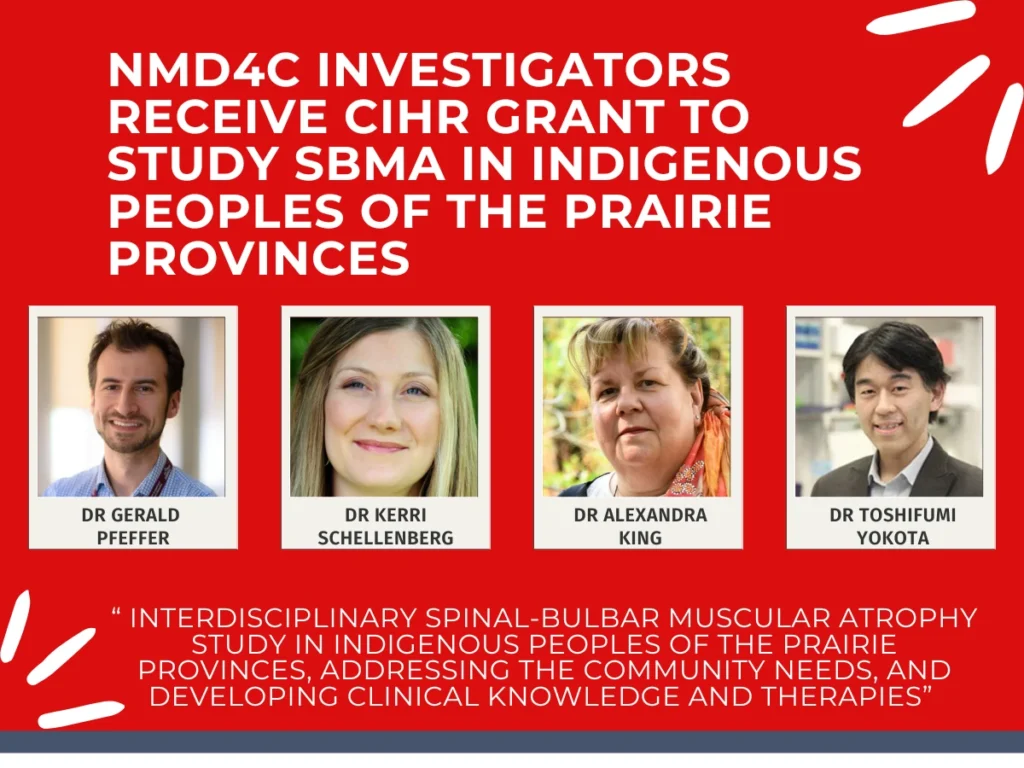
CIHR Funds Interdisciplinary Project to Study SBMA in Indigenous Peoples of the Prairie Provinces
The NMD4C is excited to share that network investigators Drs. Gerald Pfeffer, Alexandra King, Kerri Schellenberg, Toshifumi Yokota and Malcolm King have been awarded funding from the CIHR for an Interdisciplinary Spinal-bulbar muscular atrophy study in Indigenous peoples of the prairie provinces, addressing the community needs, and developing clinical knowledge and therapies. Congratulations to the entire team behind this successful grant application! The grant received funding through a CIHR project grant, for a total of $1.3 million over a five-year period.
Leading grant investigators Dr Gerald Pfeffer, Dr Alexandra King and Dr Kerri Schellenberg share that “Our initial study in 2021 established a high prevalence of SBMA in Indigenous populations in Saskatchewan, and we are excited to have the opportunity to continue this work, reaching more individuals from affected communities and together building a more robust understanding of SBMA in the Indigenous populations in Saskatchewan. However, our goal is not only to advance the genetic understanding of the disease, but to also increase communal awareness and knowledge of SBMA and to work together with Indigenous populations to understand how resources and care can be provided to help affected individuals and communities.”
Project Summary:
Spinal-bulbar muscular atrophy (SBMA) is a rare adult-onset genetic disease that affects nerves and muscles causing weakness affecting the face and neck, arms and legs, and muscles of breathing, and also affects other organs such as the heart, pancreas, liver, sensory, and reproductive systems.
This interdisciplinary study will build on a past pilot study from the team that showed Indigenous people in Saskatchewan have the highest prevalence of SBMA in the world, with genetic studies showing this prevalence being due to a founder effect meaning that there is a common ancestor with this condition, and that the mutation has been passed on over time. The study team will build on these preliminary results and perform a comprehensive study of SBMA, building and extending existing connections to affected communities, bring attention to the resiliency of Indigenous people with SBMA with a photovoice study, and highlight the needs of the SBMA community.
Throughout, the team will engage with communities to determine whether additional resources and supports can be provided to help manage this chronic health condition and determine how best to provide education and other support.
The study team seeks to collaborate with other neuromuscular specialists across Canada to aid in identifying individuals who have SBMA and invite them to participate in the study. Those who consent to participate will be asked to provide clinical information and the option to provide blood samples for further study. This will let the team test potential future therapies for SBMA. If you are a neuromuscular specialist interested in helping with recruitment for the study, please contact Dr Gerald Pfeffer at .
Full Grant Team:
Principal investigators: Drs. Gerald Pfeffer, Alexandra King, Kerri Schellenberg, Toshifumi Yokota
Co-applicants: Drs. Kehinde Ametepee, Malcolm King, Jamie N Leckie, Rika Maruyama, Ashley Secundiak
Read next...
Scheduled Maintenance
Please note that this website, imPORTND, and the NNLS training platform will undergo maintenance from July 23 until July 27, 2026.
Discover Neuromuscular Talent Across Canada
The NMD4C Neuromuscular Talent Pool is now live with new trainees! We invite supervisors and research groups to explore the Talent Pool to identify candidates whose skills, experience, and interests align with your work and upcoming positions. Trainees interested in being included in the Neuromuscular Talent Pool can register by completing the short form, uploading a CV and brief personal statement outlining their experience, interests, and career goals. For more information and to access the Talent Pool, please visit our website.
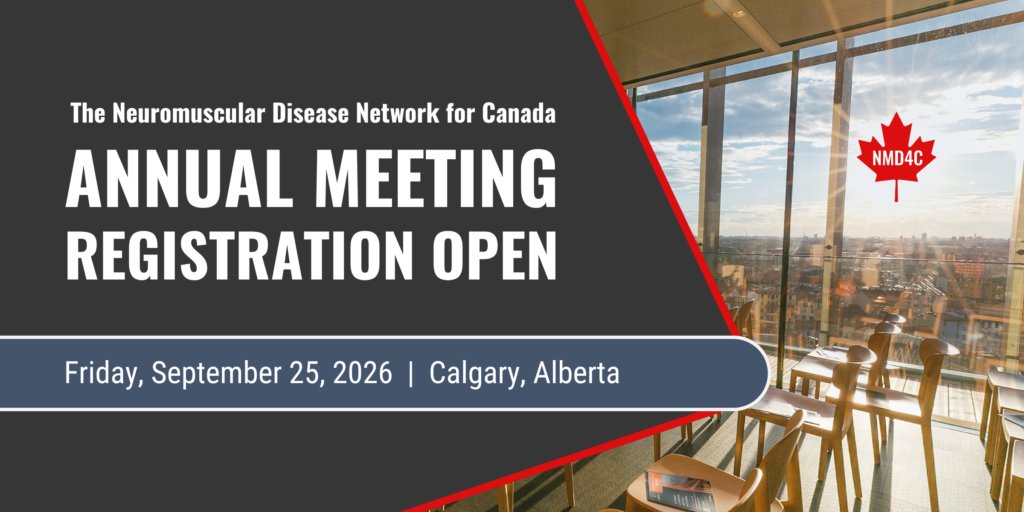
Join Us at the 2026 NMD4C Annual Meeting on 25 September
The 2026 NMD4C Annual Meeting will take place in Calgary on Friday, September 25, 2026. The agenda will feature a brief network update, trainee and early-career recognitions, flash talks, a health economics research showcase, and a series of cross‑disciplinary and parallel clinical/pre‑clinical discussion sessions to explore key topics, including advocacy and therapy access, strategies to sustain and strengthen pre-clinical programs, and network sustainability and strategic planning.