Lower Extremity Muscle Strengthening Program in Myotonic Dystrophy Type 1 from Groupe de recherche interdisciplinaire sur les maladies neuromusculaires
Myotonic dystrophy (DM1) is a rare hereditary disease that presents with several clinical manifestations including muscle weakness, apathy and fatigue. Currently it is only possible to treat the symptoms of the disease and not the disease itself. To help address the symptoms experienced by people with DM1, the Groupe de recherche interdisciplinaire sur les maladies neuromusculaires (GRIMN) developed a muscle strengthening program which has led to significant gains in muscle strength, functional capacity, decreased apathy and reduced fatigue (1,2,3).
GRIMN recently created a video aimed at health professionals that provides an in-depth explanation of the DM1 training parameters used in their studies. This video presents a strength training program designed for individuals with DM1
This resource is primarily intended for healthcare professionals working with the DM1 population, particularly physiotherapists who are most directly involved in implementing strength training interventions. It is also relevant for individuals living with DM1, who are encouraged to present it to their healthcare providers.
The video is available in both English and French on the GRIMN web page.
- Gallais, M. P. Roussel, L. Laberge, L. J. Hebert, E. Duchesne, Impact of a 12-week Strength Training Program on Fatigue, Daytime Sleepiness, and Apathy in Men with Myotonic Dystrophy Type 1. J Neuromuscul Dis 9, 629-639 (2022).
- Girard-Cote et al., Resistance training in women with myotonic dystrophy type 1: a multisystemic therapeutic avenue. Neuromuscul Disord 40, 38-51 (2024).
- P. Roussel, L. J. Hebert, E. Duchesne, Strength-training effectively alleviates skeletal muscle impairments in myotonic dystrophy type 1. Neuromuscul Disord 30, 283-293 (2020).
Read next...
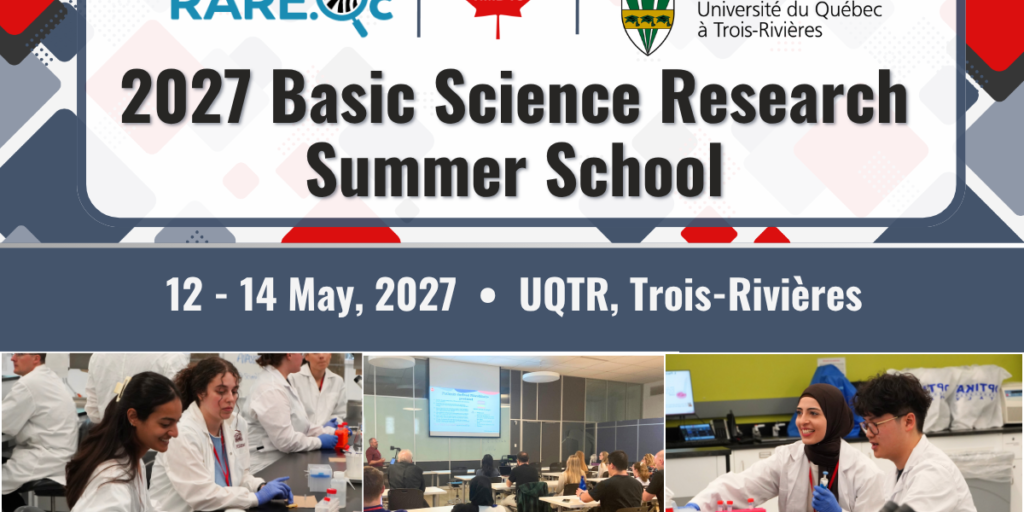
Save the Date: 2027 NMD4C-RARE.Qc Basic Science Research Summer School
NMD4C and RARE.Qc are pleased to announce the 2027 NMD4C–RARE.Qc Basic Science Research Summer School, will take place May 12-14, 2027, at the Université du Québec à Trois-Rivières (UQTR). The Summer School will bring together graduate students, postdoctoral fellows, and early-career researchers for hands-on training workshops, scientific lectures, trainee presentations, networking opportunities, and engagement with leading experts in neuromuscular and rare disease research.
Now Open: 2027 Postdoctoral Research Fellowship Funding Competition
Deadline: Oct 14 2026 | We are happy to announce that applications for the 2027 Postdoctoral Research Fellowship Funding Competition, in partnership with Muscular Dystrophy Canada, is now open. This annual funding competition awards salary support to early-career scientists in interested in advancing their postdoctoral studies in neuromuscular disease (NMD) research.
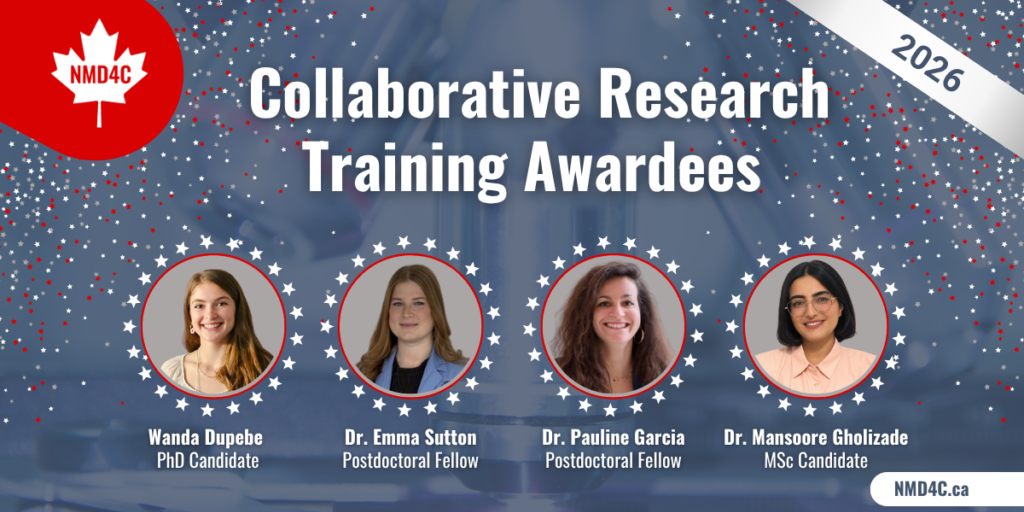
Congratulations to our 2026 Collaborative Research Training Award Recipients!!!
We are excited to announce the recipients of the 2026 NMD4C Collaborative Research Training Awards, which supports Canadian trainees in their efforts to advance neuromuscular disease research while strengthening national collaboration among neuromuscular research laboratories.