Neuromuscular Research Funding Announcements From Jesse’s Journey and Muscular Dystrophy Canada
The NMD4C is excited to share recent grant funding announcements from two of our partners, Jesse’s Journey and Muscular Dystrophy Canada. The network is incredibly fortunate to be able to collaborate with these incredible organizations, and it is our pleasure to recognize the contributions of each towards helping to fund neuromuscular research.
Jesse’s Journey
Jesse’s Journey, Canada’s leader in Duchenne muscular dystrophy funded research, will grant $1.7M toward four promising research projects this year – the largest annual amount in its 26-year history.
Newly funded projects in 2021 include:
Dr. Niclas Bengtsson: Development of gene regulatory cassettes that enable safe- and efficient in vivo dystrophin gene-editing in muscle stem cells.
Dr. Natasha Chang: Inducing stress granule formation in muscle stem cells to treat DMD.
Dr. Ronald Cohn: Simultaneous DMD gene editing and upregulation to restore protective levels of full-length dystrophin in the treatment of DMD duplication mutations.
Dr. Sachiko Sato: Development of a Monosaccharide Therapy Using N-Acetylglucosamine to Mitigate Duchenne Muscular Dystrophy.
The growth in scientific funding interest is encouraging for the community because it means there is an increasing commitment to Duchenne science and drug discovery, bringing hope and progress towards prevention, treatment, and ultimately – a cure.
Read the full press release from Jesse’s Journey here!
Muscular Dystrophy Canada
Muscular Dystrophy Canada (MDC) has announced an investment of $400,000 to fund seven new research projects in 2021 through the MDC Neuromuscular Disorder (NMD) Research Grant Competition, a dedicated Canadian source of funding for neuromuscular research. MDC will also invest in an international, collaborative, $1.15 million, research project through the European Joint Programme on Rare Diseases (EJP RD).
The 2020-2021 research grant recipients are:
Dr. Alex Parker: A Pharmacogenetic Pipeline for Charcot-Marie-Tooth Disease
Dr. Colin Crist: Promoting Muscle Repair by Pharmacological Inhibition of eIF2a Dephosphorylation
Dr. Mohamed Chahine: Human iPSC-derived Neurons as a Model of Congenital Myotonic Dystrophy Type 1
Dr. Nadine Wiper-Bergeron: Improving Myoblast Transplantation Outcomes via Pharmacological Reprogramming
Dr. Nicolas Dumont: Targeting Defective Stem Cells in a Preclinical Model of Myotonic Dystrophy Type 1
Dr. Rima Al-Awar (EJPRD/CIHR Co-funded): Safety and Efficacy of a Possible Epigenetic Therapy for Facioscapulohumeral Muscular Dystrophy
Dr. Toshifumi Yokota: Enhancing the Efficacy of Antisense Oligonucleotide Therapy for Facioscapulohumeral Muscular Dystrophy
Read the full press release from Muscular Dystrophy Canada here!
Read next...
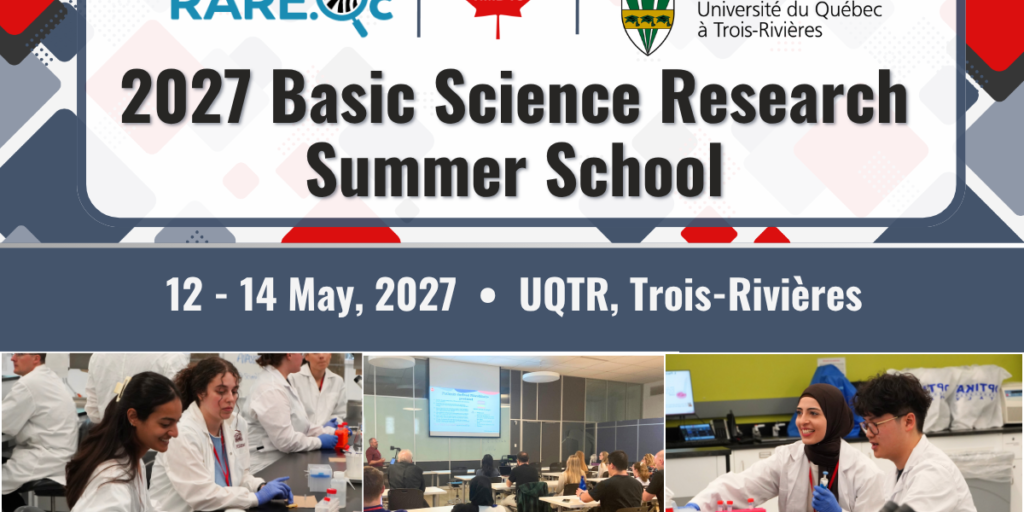
2027 NMD4C–RARE.Qc Basic Science Research Summer School Applications Are Now Open!
Deadline: December 1, 2026
2027 NMD4C–RARE.Qc Basic Science Research Summer School Applications Are Now Open!
The summer school offers neuromuscular and rare disease research trainees the opportunity to participate in an intensive three-day training program focused on cutting-edge experimental and translational research techniques.