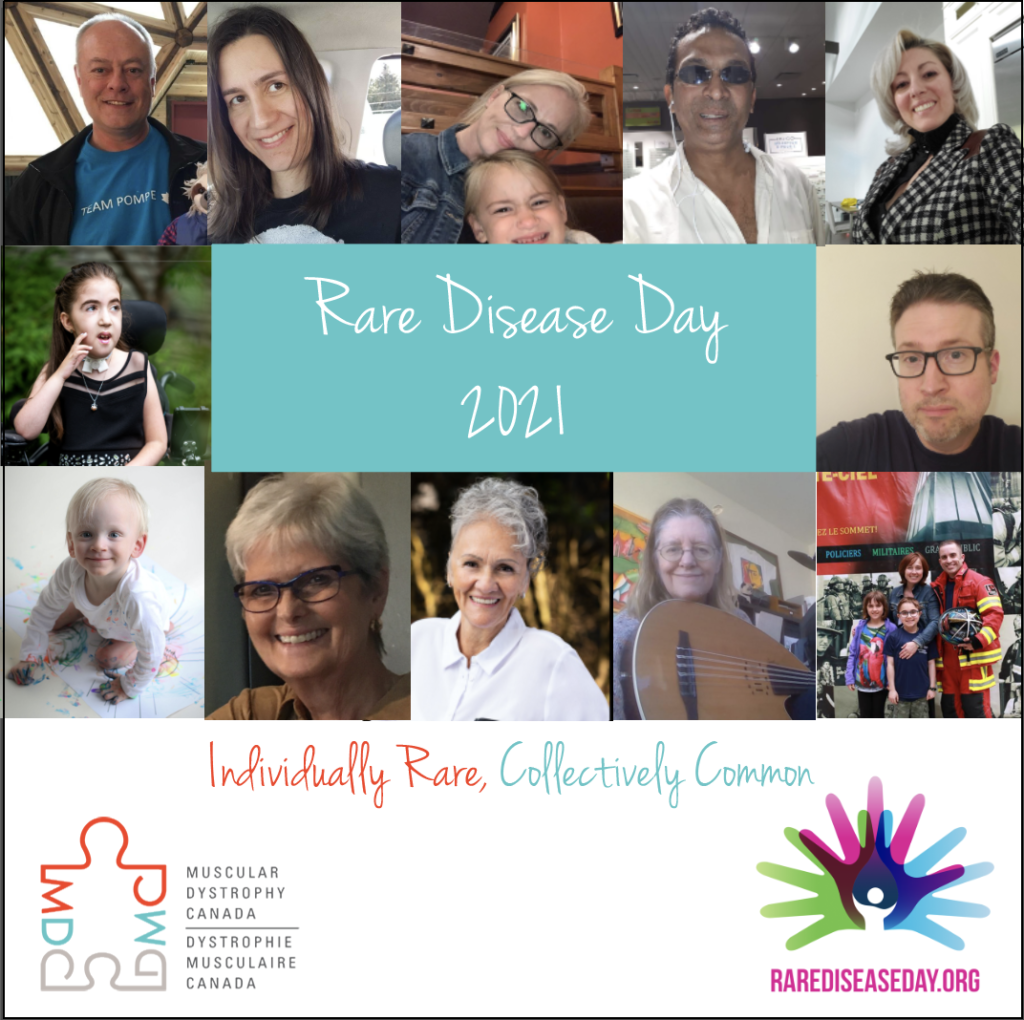
Rare Disease Day 2021 Recap
Observed annually on the last day of February, Rare Disease Day seeks to raise awareness among the general public, as well as policymakers, public authorities, industry representatives, scientists, and health professionals.
Due to the COVID-19 pandemic, activities this year were mainly virtual. But that did not stop patients, caregivers, researchers, clinicians, advocates and patient organizations like MDC from sharing stories on social media platforms, participating in academic and community discussions, and holding virtual campaigns to “recognize rare.” In the days leading up to Rare Disease Day, MDC celebrated by bringing awareness to different groups of neuromuscular disorders. MDC also shared powerful stories of on how children and adults are managing their rare disease during the COVID-19 pandemic.
The stories highlighted the resilience of individuals and their families, the benefits of virtual tele-care and programs for those with mobility challenges and the positive lessons the pandemic has offered.
Click here if you missed the stories!
Rare Disease Day also served as a great opportunity to share exciting announcements, like:
-
- The declaration of International Myotonic Dystrophy Day as September 15, 2021. This day is a collaboration of dozens of myotonic dystrophy groups and organisations from around the globe – each dedicated to helping raise awareness of the condition in their local geographies on September 15, 2021 and beyond. The NMD4C & MDC are proud to be a part of this global alliance in declaring September 15th International Myotonic Dystrophy Awareness Day!
Help change the future of myotonic dystrophy! In honor of #RareDiseaseDay join the global alliance declaring September 15th International Myotonic Dystrophy Awareness Day! Read our joint press release to learn how you can get involved: https://t.co/fMjvmnfmvd pic.twitter.com/qEXf9T5s3L
— Myotonic Dystrophy Foundation (@MyotonicStrong) February 26, 2021
- The results of the European Joint Programme for Rare Diseases (EJP RD) JTC 2020 call on pre-clinical research were announced. ProDGNE, a project which will unify European and Canadian (Dr. Hanns Lochmuller) efforts to develop an innovate therapeutic approach for GNE myopathy, an ultra-rare muscle disease, obtained co-funding under the EJP RD JTC 2020 call on pre-clinical research.
On #RareDiseaseDay we are proud to announce and celebrate #proDGNE has obtained @EU_H2020 co-funding under the @EJPRareDiseases #JTC2020 call on Pre-clinical #Research. The project will unify European&Canadian efforts to develop an innovative therapeutic approach for #GNEMyopathy pic.twitter.com/W5XYzPI113
— ProDGNE (@ProDGNE) February 28, 2021
- MDC has been in partnership with CIHR in the EJP RD competition since 2013. This year, MDC together with CIHR will support the FSHD (EPiTHE4FSHD) (Facioscapulohumeral muscular dystrophy) study (Dr. Rima Al-Awar), which aims to use cellular and animal models of FSHD to investigate a novel pharmacological approach that could represent a promising therapeutic option for patients.
Rare Disease Day also helped bring the neuromuscular community up in media. Muscular Dystrophy Canada and Jesse’s Journey were pleased be part of a 2021 Rare Disease Day initiative called Canada’s Rare Voices. This is an online program, the largest of its kind in recent memory, devoted entirely to increasing the visibility of Canada’s rare disorder communities. MDC was featured in a story about the power of partnerships – teaming up to take on neuromuscular disorders.
Read next...

Six Annual NMD4C and MDC Clinical Fellowship Competition from Opens May 1st
Together, NMD4C and MDC are excited to open our 2027 annual funding competition to provide clinical fellowship award(s) in neuromuscular medicine and electromyography (EMG)! This annual funding competition provides one-year salary support ($80,000) for early-career clinicians to participate in Canadian neuromuscular medicine and EMG fellowship training programs.
Announcing the 2026 NMD4C Award Recipients
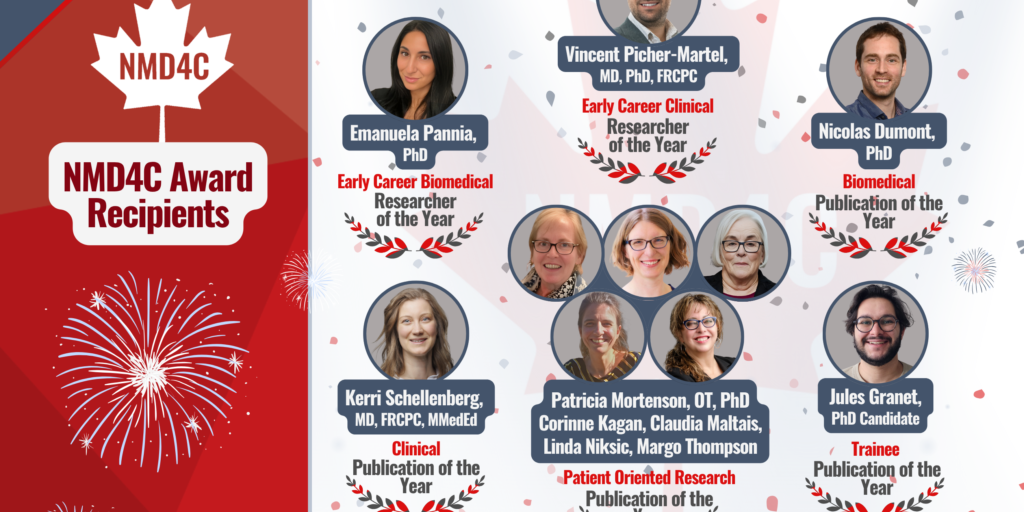
We are excited to announce the recipients of the 2026 NMD4C Awards, recognizing excellence, leadership, and impact across Canada’s neuromuscular research community. In this fourth cycle, the program introduces two new award categories, and expand on our ability to celebrate the work of contributions of trainees and patient partners who strengthen our national network.

Expanding Our Impact: NMD4C BSTC Launches New Subcommittees and Welcomes New Members
We are so excited to introduce the new members of the NMD4C Basic Science Trainee Committee! This enthusiastic group of researchers from across the country is stepping up to contribute to some of our most important initiatives for trainees.