Expert Patient Capacity Building Update

Canadians with NMD, their families, and advocates are increasingly asked to take an active role in research initiatives. Research and advocacy training empowers patients and ensures they have the confidence and knowledge needed to share their expertise to guide discussions and inform decisions regarding health care, research, and therapy development for policy makers, industry, and scientists.
The NMD4C is involved in several activities under the provision of our Training and Education initiatives, including the establishment of expert patient capacity building (EPCB) resources for Canadian NMD patients. The EPCB team’s work involves the promotion of patient engagement in all aspects of NMD, and the development of easy-to-use and accessible Canadian NMD training modules and resources for both patients and researchers to support patient-oriented neuromuscular research in Canada.
To facilitate the network’s EPCB activities, the NMD4C is excited to announce the hiring of Patricia Mortenson, who has joined this team as project coordinator.
Read Patricia’s full bio here!
To assist in the development of modules to train patients and researchers to partner effectively, the EPCB team is reviewing the Canadian research landscape to find current resources and programs. Throughout all EPCB work, the team will utilize the Strategy for Patient-Oriented Research (SPOR) Patient Engagement Framework developed by CIHR. This framework allows patients to provide knowledge and input drawn from their unique experience gained through living with a condition or illness, and their first-hand experience in navigating treatments and the Canadian health care system.
The NMD4C encourages you to share any relevant expert patient capacity building resources that you know of with our team!
If you are a researcher who has experience in working with expert patients, we would also love to hear from you!
Please complete this short 5-minute survey here!
Read next...
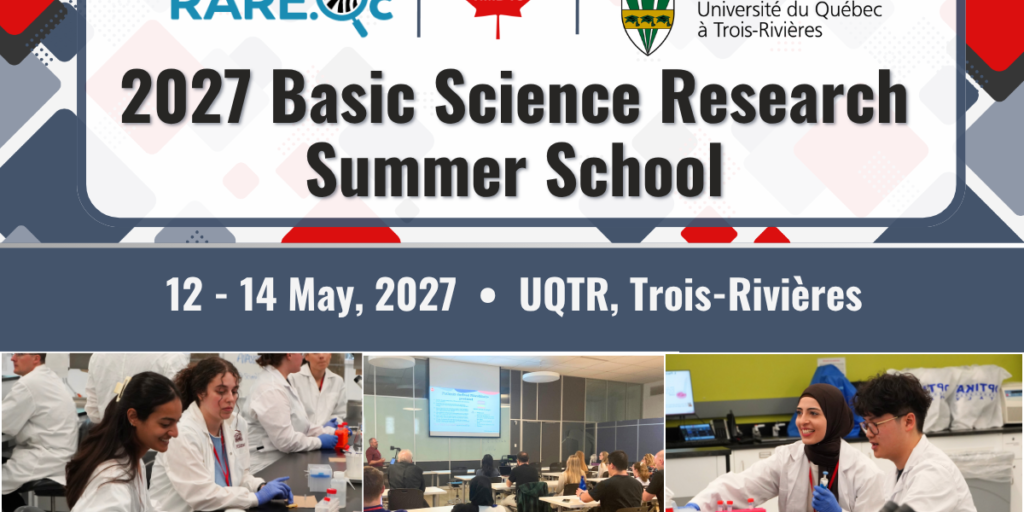
Save the Date: 2027 NMD4C-RARE.Qc Basic Science Research Summer School
NMD4C and RARE.Qc are pleased to announce the 2027 NMD4C–RARE.Qc Basic Science Research Summer School, will take place May 12-14, 2027, at the Université du Québec à Trois-Rivières (UQTR). The Summer School will bring together graduate students, postdoctoral fellows, and early-career researchers for hands-on training workshops, scientific lectures, trainee presentations, networking opportunities, and engagement with leading experts in neuromuscular and rare disease research.
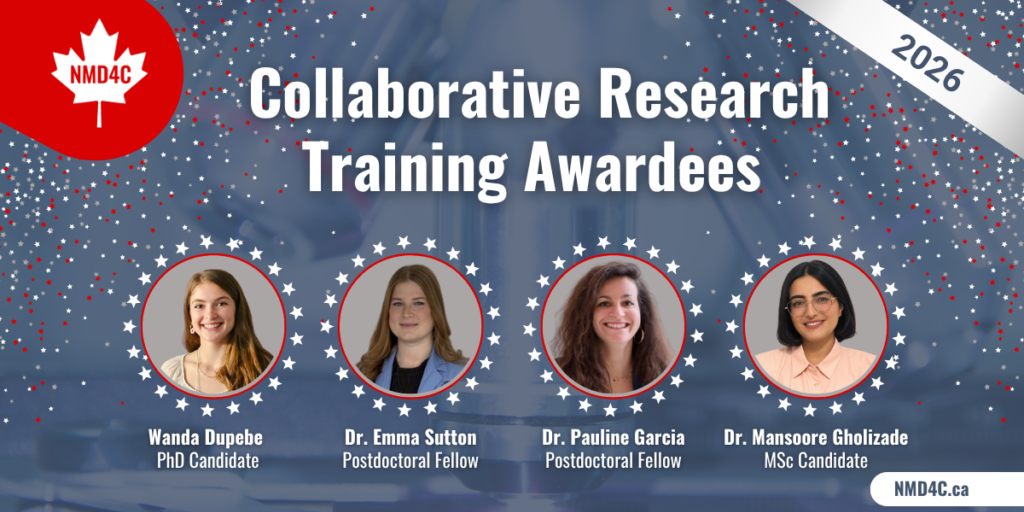
Congratulations to our 2026 Collaborative Research Training Award Recipients!!!
We are excited to announce the recipients of the 2026 NMD4C Collaborative Research Training Awards, which supports Canadian trainees in their efforts to advance neuromuscular disease research while strengthening national collaboration among neuromuscular research laboratories.
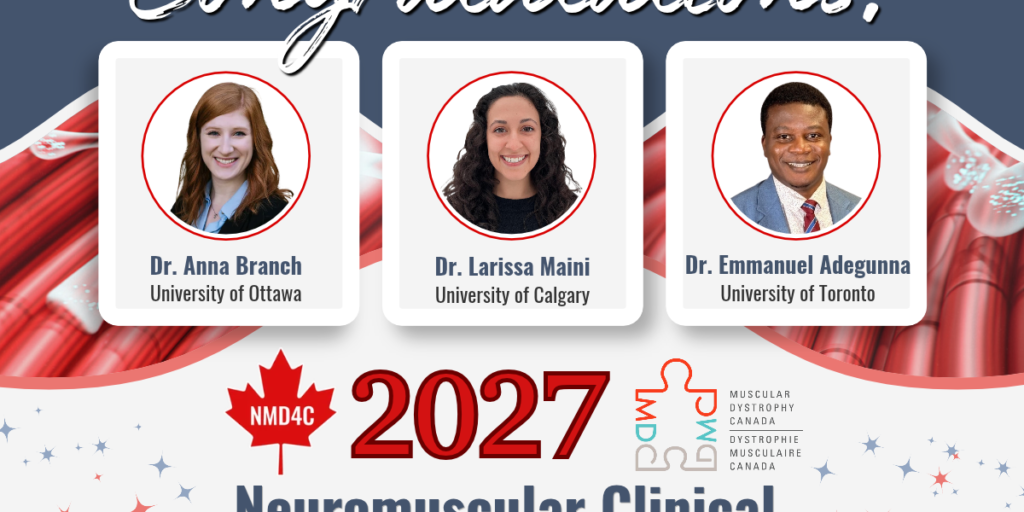
Announcing the 2027 Neuromuscular Clinical Fellowship Funding Recipients!
Together with Muscular Dystrophy Canada, we’re excited to share our 2027 Neuromuscular Clininacal Fellowship Funding Recipients; Dr. Larissa Maini (University of Calgary), Dr. Anna Branch (University of Ottawa) and Dr. Olumide Emmanuel Adegunna (University of Toronto)! This year’s competition provided one-year salary support ($80,000) for our early-career clinicians to participate in Canadian neuromuscular medicine and electromyography (EMG) fellowship training programs.