Pulmonary support for people with myotonic dystrophy during COVID-19 pandemic
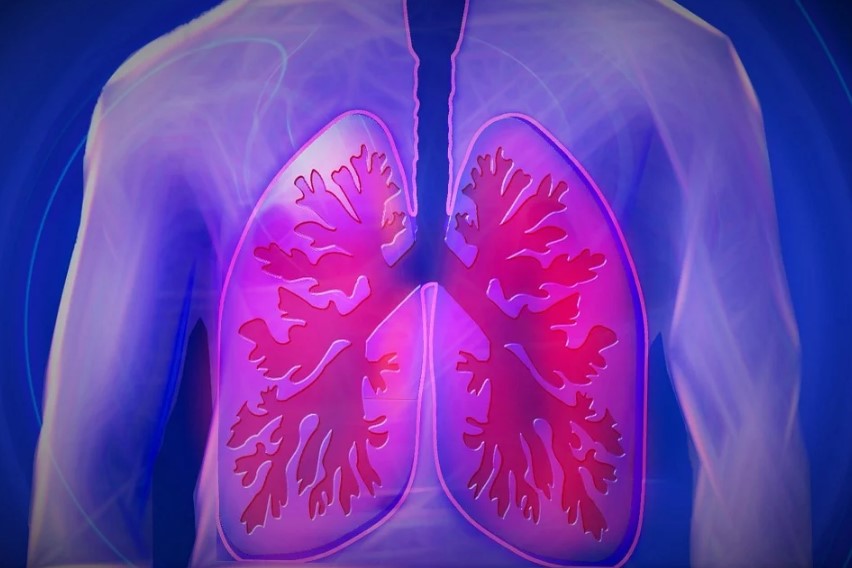
New COVID-19-related guidance has been produced for people living with myotonic dystrophy who already use some respiratory support at home or who need it if they get sick. These devices are very important to keep you breathing well, but extra care needs to be taken to make sure they are kept clean and to limit the spread of the virus, as they can increase the risk of virus-infected particles being released into the air.
Many people with myotonic dystrophy do not use ventilation when they are otherwise healthy, but some do use non-invasive ventilation at home. Others may require respiratory support if they contract COVID-19 because their breathing muscles are weaker than normal.
Specific guidelines for myotonic dystrophy patients and their doctors in case of a COVID-19 infection, created by Myotonic and the CHEST Home-Based Mechanical Ventilation and Neuromuscular Disease NetWork, can be downloaded HERE.
You can share these recommendations with your care providers and with any medical providers you have to see. Let them know you have myotonic dystrophy and that these guidelines were developed by leading pulmonologists and neurologists specifically for myotonic dystrophy patients suspected of being infected with COVID-19.
If you use respiratory support at home but are currently healthy, see additional guidance about how to avoid exposure to the coronavirus HERE.
***
De nouveaux conseils liés à la COVID-19 sont disponibles pour les personnes vivant avec la dystrophie myotonique qui utilisent déjà une aide respiratoire à domicile ou qui en ont besoin si elles tombent malades. Ces appareils sont très importants pour vous permettre de bien respirer, mais il faut veiller à ce qu’ils restent propres et à limiter la propagation du virus, car ils peuvent augmenter le risque de libération de particules infectées par le virus dans l’air.
De nombreuses personnes atteintes de dystrophie myotonique n’utilisent pas de ventilation lorsqu’elles sont en bonne santé, mais certaines utilisent une ventilation non invasive à domicile. D’autres peuvent avoir besoin d’une assistance respiratoire si elles contractent la COVID-19 parce que leurs muscles respiratoires sont plus faibles que la normale.
Les directives spécifiques pour les patients atteints de dystrophie myotonique et leurs médecins en cas d’infection par COVID-19, crées par Myotonic et traduites par NMD4C, peuvent être téléchargées ICI.
Vous pouvez partager ces recommandations avec vos professionnels de la santé et avec tous les intervenants médicaux que vous devez consulter. Faites-leur savoir que vous êtes atteint de dystrophie myotonique et que ces recommandations ont été élaborées par des pneumologues et des neurologues de renom, spécifiquement pour les patients atteints de dystrophie myotonique soupçonnés d’être infectés par COVID-19.
Si vous utilisez une assistance respiratoire à domicile mais que vous êtes actuellement en bonne santé, consultez les conseils supplémentaires sur la manière d’éviter l’exposition au coronavirus ICI.
Read next...
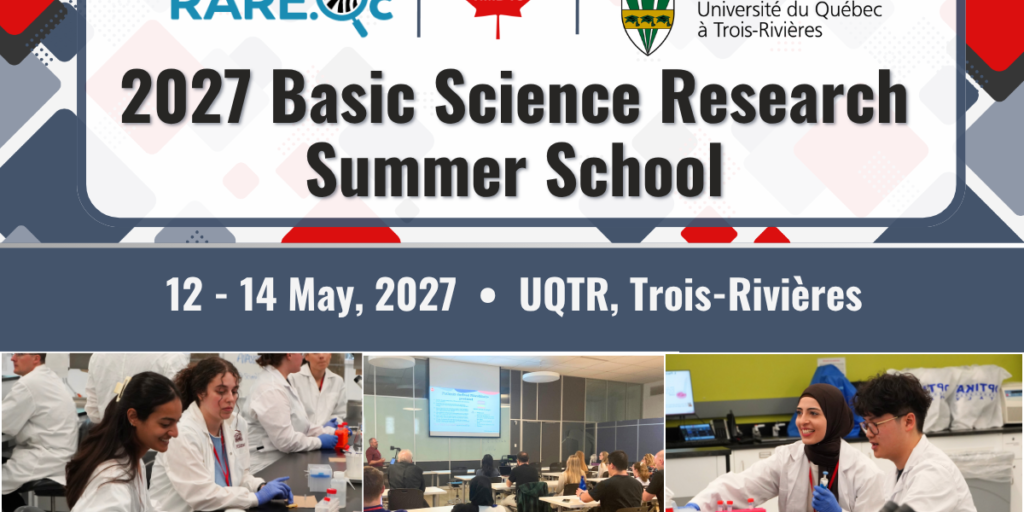
Save the Date: 2027 NMD4C-RARE.Qc Basic Science Research Summer School
NMD4C and RARE.Qc are pleased to announce the 2027 NMD4C–RARE.Qc Basic Science Research Summer School, will take place May 12-14, 2027, at the Université du Québec à Trois-Rivières (UQTR). The Summer School will bring together graduate students, postdoctoral fellows, and early-career researchers for hands-on training workshops, scientific lectures, trainee presentations, networking opportunities, and engagement with leading experts in neuromuscular and rare disease research.
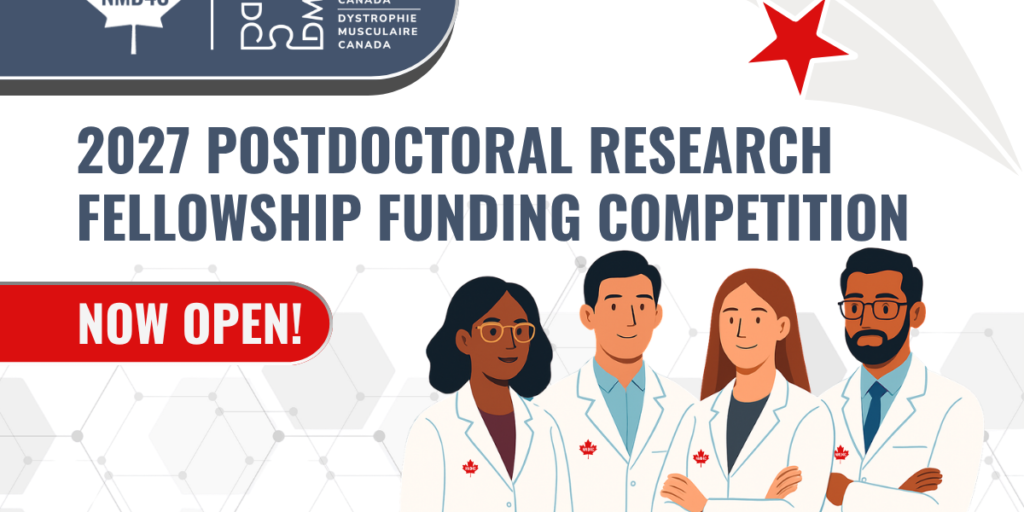
Now Open: 2027 Postdoctoral Research Fellowship Funding Competition
Deadline: Oct 14 2026 | We are happy to announce that applications for the 2027 Postdoctoral Research Fellowship Funding Competition, in partnership with Muscular Dystrophy Canada, is now open. This annual funding competition awards salary support to early-career scientists in interested in advancing their postdoctoral studies in neuromuscular disease (NMD) research.
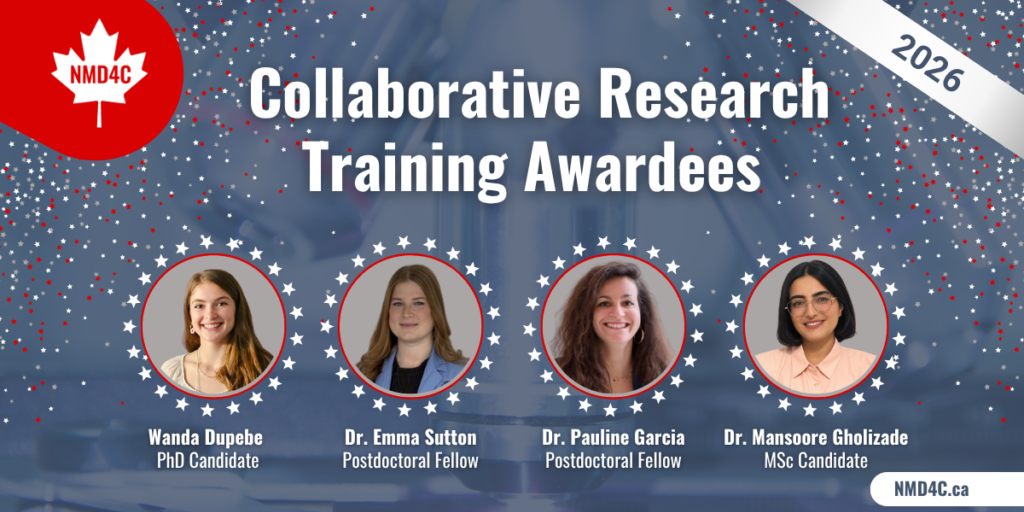
Congratulations to our 2026 Collaborative Research Training Award Recipients!!!
We are excited to announce the recipients of the 2026 NMD4C Collaborative Research Training Awards, which supports Canadian trainees in their efforts to advance neuromuscular disease research while strengthening national collaboration among neuromuscular research laboratories.