Canadian Neuromuscular Disease Registry Launches New Congenital Myasthenic Syndrome Registry
We’re delighted to announce that a new registry for patients with congenital myasthenic syndrome (CMS) has just been launched within the Canadian Neuromuscular Disease Registry (CNDR). This new initiative is led by Dr. Hanns Lochmüller as an academic study as a part of Dr. Lochmüller’s CIHR foundation grant for CMS research, and supported by the NMD4C.
CMS are a diverse group of disorders that have an underlying defect in the transmission of signals from nerve cells to muscles. These disorders are characterized by muscle weakness that is worsened upon exertion[1]. The prevalence of CMS in populations under 18 years was measured to be between 2.8 and 14.8 per million children in a UK-based prevalence study[2]. This situates CMS as one of the rarer neuromuscular conditions, and there are over 30 different genes that may be involved.
By registering all patients across Canada, including those who have the clinical hallmarks of CMS but don’t yet have a genetic diagnosis, the aim of this registry is to improve access to diagnosis and treatment and develop a Canadian CMS cohort for future research. Individuals living with CMS can self-register directly with the CNDR or can register in-clinic if their local clinic is affiliated with the CNDR. Clinical centres that are already affiliated can activate the CMS module by going through a minor amendment with their REB – please contact Adrienna Dyck of the CNDR at to find out how to find out how. Since CMS is so rare, every new registration makes a difference!
The CNDR is a Canada-wide registry of people diagnosed with a neuromuscular disease, collecting important medical information from patients across the country to improve the understanding of neuromuscular disease and accelerate the development of new therapies. Currently, over 4500 neuromuscular patients have registered from across Canada. The new CMS registry is the latest addition to the CNDR’s current registries, which include Amyotrophic Lateral Sclerosis (ALS), Duchenne Muscular Dystrophy (DMD), Limb Girdle Muscular Dystrophy (LGMD), Myotonic Dystrophy (DM), Spinal Muscular Atrophy (SMA). The CNDR also collects information on other NMDs.
The network would like to give special recognition the CNDR’s Dr. Victoria Hodgkinson and Adrienna Dyck, and the Lochmüller Lab’s Dr. Rachel Thompson for their contributions to the CMS registry project, as well as members of the expert group who helped refine the dataset: Drs. Lawrence Korngut, Kathy Selby, Craig Campbell, Hugh McMillan, Nicolas Chrestian, and Dr. Hanns Lochmüller.
[1] NORD (National Organization for Rare Disorders). 2022. Congenital Myasthenic Syndromes – NORD (National Organization for Rare Disorders). [online] Available at: <https://rarediseases.org/rare-diseases/congenital-myasthenic-syndromes/> [Accessed 24 February 2022].
[2] Parr, J., Andrew, M., Finnis, M., Beeson, D., Vincent, A. and Jayawant, S., 2014. How common is childhood myasthenia? The UK incidence and prevalence of autoimmune and congenital myasthenia. Archives of Disease in Childhood, 99(6), pp.539-542.
Read next...
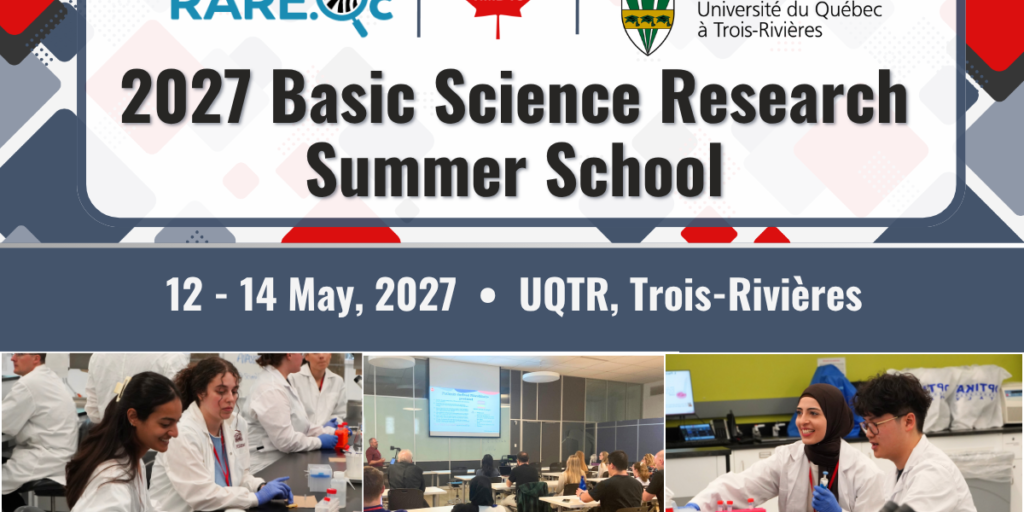
2027 NMD4C–RARE.Qc Basic Science Research Summer School Applications Are Now Open!
Deadline: December 1, 2026
2027 NMD4C–RARE.Qc Basic Science Research Summer School Applications Are Now Open!
The summer school offers neuromuscular and rare disease research trainees the opportunity to participate in an intensive three-day training program focused on cutting-edge experimental and translational research techniques.